The Big MAT Book: Courseware for Audio & Multimedia Engineering
Stephen Travis Pope
(faculty 1995-2010) Graduate Program in Media Arts and
Technology, and Dept. of Music, and Dept. of Computer Science
University of California. Santa Barbara
TheBigMATBook
is a set of course materials (presentation slides, readers and code
examples) for twelve ten-week courses on topics related to multimedia
engineering. This material was developed for delivery in the Graduate
Program in Media Arts and Technology (MAT) at the University of
California, Santa Barbara (mat.ucsb.edu).
It is published here for the free use of anyone at all. See the longer
introduction below.
Volume 1: Multimedia Engineering (4 courses,
350 pages, 2088 slides)
Volume 2: Audio Software (6 courses, 251
pages, 1518 slides)
Volume 3: Audio Hardware (2 courses, 147
pages, 882 slides)
Downloads
Covers of the 3 volumes (click on them to see the PDF versions)
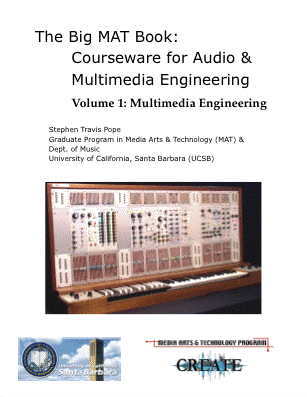
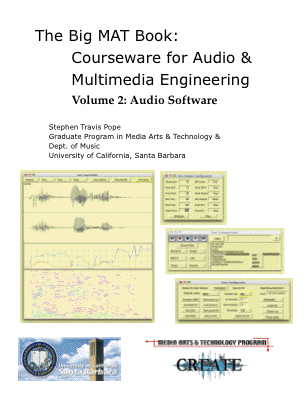
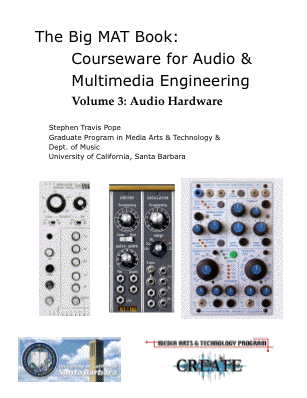
Table of Contents
Volume 1: Multimedia Engineering (Core courses)
A. Survey of Media Engineering &
Technology
EE/CS topics, data/signal/symbol,
models and representations, media I/O devices
B. Media Signal Processing
Multimedia data representation;
signal synthesis, analysis and processing
C. Computing with Media Data
Multimedia programming techniques
and APIs, software development topics and tools
D. Sensors and Interfaces for Media Art
Space and gestural interaction,
transducers and sensors, Arduino-like microcontrollers
Volume 2: Audio Software (Digital Audio Programming 6-part Series)
A. Sound IO and Streaming APIs
Sound I/O libraries for modern
computing platforms, audio plug-in APIs
B. The Spectral Domain: Filter and the FFT
Digital filters and frequency
transforms, FFT implementations, vocoders, applications
C. Spatial/Surround Sound and Reverb
Formats for spatial- and
surround-sound, synthesis of spatial queues, reverberation techniques
D. Sound Synthesis Techniques
Additive, subtractive and non-linear
synthesis, physical modeling, granular synthesis, applications
E. Control and Distributed Programming
MIDI and OSC libraries and
applications, USB HID programming
F. Databases and Music Information Retrieval
Audio signal analysis and feature
extraction, music segmentation, classification, applications
Volume 3: Audio Hardware
A. Audiophile Engineering
Principles of Hi-Fi, critical
listening, room acoustics, components of the audio signal chain
B. Recording Studio Design
Studios and control rooms, the
recording signal processing chain, mixing and mastering, new media systems
Introduction to the Series
“Courseware for Audio & Multimedia Engineering”
Multimedia engineering is a broad
and complex topic. It is also one of the fastest-growing and most valuable
fields of research and development within electronic technology. The book
before you is an anthology of curriculum materials developed over the space
of 12 years at the University of California, Santa Barbara for students in
UCSB’s Graduate Program in Media Arts and Technology.
TheBigMATBook consists of the
presentation slides for twelve ten-week courses, amounting to over 600 hours
of presentation time. For each of the twelve courses, the presentation
slides are accompanied by the tables of contents of the course readers, and
an overview of the example code archives. These resources are available for
down-load from the HeavenEverywhere web site (see
http://HeavenEverywhere.com/TheBigMATBook).
The multimedia engineering courses included here cover theory and practice,
hardware and software, visual and audio media, and arts as well as
entertainment applications. Some of the courses (the first two chapters) are
required of all MAT graduate students, and thus must target less-technical
and also non-audio-centric students. The bulk of this material, though,
consists of elective courses that have somewhat higher-level prerequisites
and assume basic knowledge of acoustics and some (minimal) programming
experience in mainstream programming languages.
TheBigMATBook courses borrow
liberally from R&D publications by my friends and colleagues, especially
Roger Dannenberg, Julius O. Smith, D. Gareth Loy, F. R. Moore, Perry Cook,
Adrian Freed, George Tzanetakis, Ross Bencina and Dan Overholt. I want also
to express my deepest thanks to my MAT and Music Dept. colleagues JoAnn
Kuchera-Morin, Curtis Roads, Clarence Barlow, Matthew Wright and Matthew
Turk, and to the many students who helped these courses evolve, either as
course participants or teaching assistants.
Stephen
Travis Pope
Santa Barbara, California
Updated January, 2014